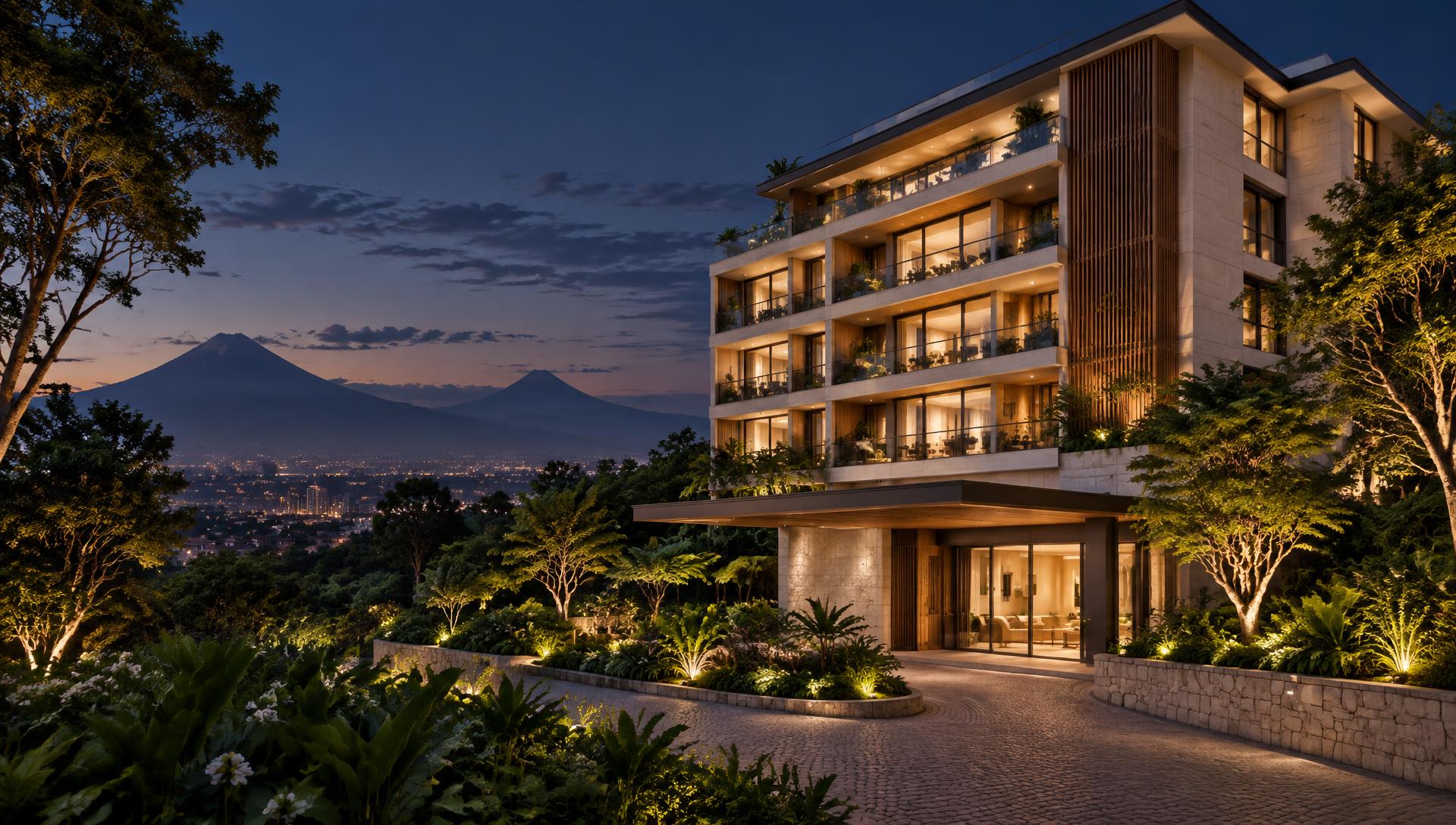
Project in development. Not yet built or operating. · Conceptual image · not the final design
Investment highlights
Project economics and an illustrative case, kept separate.
A real estate asset. A specialized operating business. A growth opportunity in Guatemala.
A · Project-level economics
Modeled investment in the asset
US$5.83M
Modeled investment in the asset
Total equity requirement, incl. pre-opening and ramp-up
US$3.30M
Total equity requirement, incl. pre-opening and ramp-up
Projected 2030 annual revenue
US$3.62M
Projected 2030 annual revenue
Projected 2030 annual EBITDA
US$1.28M
Projected 2030 annual EBITDA
Projected stabilized EBITDA margin
35.3%
Projected stabilized EBITDA margin
Modeled stabilized yield on cost
22.0%
Modeled stabilized yield on cost
Yield on cost is an asset-level measure; it is not an individual investor's annual return.
B · Illustrative case: land-contribution investor.
Investor type: land contributor
Initial contribution, incl. land and associated stamp duties
US$566,500
Initial contribution, incl. land and associated stamp duties
Projected net IRR
18.6%
Projected net IRR
Projected MOIC (6.36x)
~6.4x
Projected MOIC (6.36x)
Total projected receipts through 2040
~US$3.60M
Total projected receipts through 2040
The 18.6% IRR and 6.4x multiple are not the expected return for every investor or ticket. Other investors' returns depend on contribution timing, investment class, preferred return and final terms.
Base-case projections. Returns, distributions and recovery of capital are not guaranteed.
Investment thesis
Five pillars of the opportunity.
01
Real estate foundation
A planned assisted living facility supported by land and a purpose-designed building.
02
Structural need
The project targets households seeking professional residential care for older relatives.
03
Operating model
Resident accommodation and care services generate recurring revenue, subject to occupancy, pricing, staffing and execution.
04
Professional execution
The proposed model combines real estate development, operating procedures, clinical coordination, hospitality and governance.
05
Expansion potential
The initial site is intended to establish a repeatable operating model for future locations.
Market opportunity
A concrete need, a defined target market.
~740,000Households in the metropolitan corridor
~26,000ABC1 households
~5,700ABC1 households with at least one adult aged 65+
~1,138Households with an older adult with functional or neurocognitive dependency
92 occupied beds would represent approximately 8% of that estimated target-household pool.
Methodology: the team's market-sizing model. Households are not confirmed customers, and the calculation is not proof of willingness to pay.
Estimated private supply in the metropolitan area: ~360 beds (internal estimate, not a verified official count).
Early demand development
A commercial strategy that starts before opening.
physicians consulted
8
physicians consulted
potential referrals identified
40–48
potential referrals identified
Preliminary, non-binding indications. Conversion depends on formalization and each family's admission decisions.
Next steps
1.Formalize referring relationships.
2.Develop hospital relationships.
3.Build the pre-opening pipeline.
4.Convert interest into assessed and documented admissions.
Location
A project in a residential setting in Guatemala City.
The identified site is in Vista Hermosa IV, Zone 16, Guatemala Municipality, in the CAES corridor area. A residential setting that supports family proximity, access and connection to the target residential market.
Address
Lote 133, Vista Hermosa IV, Guatemala Municipality, Guatemala Department
The map shows the Google Maps search result for the address given. Please verify it before a visit.
Development and architecture
100 beds, with technical pre-feasibility completed.
Preliminary FORMA v02 study · May 18, 2026
Residential · level 4
Residential · level 3
Residential · level 2
Residential · level 1
Parking · 39 spaces
Conceptual image · not the final design
Planned beds
100
Planned beds
Accommodation units
61
Accommodation units
Total construction
~4,178 m²
Total construction
Allocated to parking
~944 m²
Allocated to parking
Levels: 1 parking + 4 residential
5
Levels: 1 parking + 4 residential
Parking spaces
39
Parking spaces
Preliminary accommodation units
~25–29 m²
Preliminary accommodation units
Figures from a conceptual massing and feasibility study. They do not represent a final licensed architectural design. Planning approval, building permits and operating licenses have not yet been granted. Construction area includes non-habitable areas.
Operating concept
Four connected operating areas.
Resident experience
Admissions, family relationships, activities, accommodation and hospitality.
Clinical operations
Nursing, medication processes, medical coordination, nutrition and rehabilitation.
Hospitality operations
Housekeeping, laundry, food service, maintenance and security.
Business operations
Finance, commercial activity, staffing, administration and compliance.
Employees modeled at opening
26
Employees modeled at opening
Employees modeled at stabilization
92
Employees modeled at stabilization
Residents at 92% occupancy
92
Residents at 92% occupancy
Employee per resident (total workforce)
~1.0
Employee per resident (total workforce)
This is total modeled headcount, not one dedicated caregiver per resident or a simultaneous on-duty ratio. 24/7 coverage is a proposed operating feature and does not mean round-the-clock on-site physician presence.
Processes and execution capability
Quality is designed into processes.
Documented procedures are part of the team's operating foundation and its planned transfer to Guatemala. The Guatemala facility is not yet operating and has not been audited, licensed or certified.
Resident and family admission
Staff onboarding
Medication management
Nursing care
Skin and pressure-injury care
Continence support
Laundry and textiles
Waste management and biosecurity
Internal manuals are shared only through the due diligence process.
Team
Experience across healthcare, real estate and structuring.
IF
Iván French
Operating Partner
Physician trained at Mount Sinai and NYU, MBA from Harvard Business School, and healthcare M&A experience at Morgan Stanley, including the US$2.8Bn Brookdale–Emeritus transaction. Experience building and managing businesses in Latin America.
JN
Julio Noriega
Real Estate Development Partner
Managing Partner at Prime. More than 18 years of real estate experience, over US$500M in real estate transactions led or advised, and participation in more than US$5Bn of regional structuring and M&A.
FR
Francisco Reynal
Legal and Structuring
Experience in business structuring, contracts, compliance and real estate investment.
MG
Malcolm Graham
Asset Management and Risk
Experience in asset management, risk and regional operations, including leadership at Control Union and executive education at Kellogg.
Biographies and portraits subject to each member's approval.
Capital requirement
A capital structure to develop and launch the asset.
Uses
Asset investmentUS$5.83M
Pre-opening and ramp-up~US$0.39M
Sources
Modeled debt~US$2.91M
Investment equity~US$2.91M
Additional equity~US$0.39M
Total modeled funding need
~US$6.22M
Total modeled funding need
Total equity requirement
~US$3.30M
Total equity requirement
Figures are rounded.
Debt assumptions: 7.5% interest, 24 months of grace and subsequent amortization over 13 years. Bank financing is not committed.
The US$5.83M underwriting budget includes ~US$261,000 of additional equipment over the FORMA estimate of ~US$5.57M.
Operating projections
Projected EBITDA after management fee.
US$1.00M
US$1.28M
US$1.72M
202920302040
Only the supplied data points are shown; no intermediate annual figures are presented.
Projected 2030 revenue
US$3.62M
Projected 2030 revenue
Stabilized EBITDA margin
35.3%
Stabilized EBITDA margin
Stabilized occupancy
92%
Stabilized occupancy
Management fee included in the model
10%
Management fee included in the model
Annual USD price and cost escalation from 2029
3%
Annual USD price and cost escalation from 2029
Projected revenue mix
Residence 91.6%
Day hospital 5.6%
Rehabilitation 2.8%
EBITDA is not distributable cash or net investor income.
+How returns change under different assumptions.
Sensitivities · Occupancy
Stabilized EBITDA
US$1.28M
Stabilized EBITDA
Land-investor IRR
18.6%
Land-investor IRR
Land-investor MOIC
6.36x
Land-investor MOIC
Separately modeled cases holding other assumptions constant. No scenario is a guaranteed downside floor.
+Modeled sale in 2040.
2040 EBITDA
~US$1.72M
2040 EBITDA
Assumed exit capitalization rate
9%
Assumed exit capitalization rate
Gross modeled exit value
~US$19.1M
Gross modeled exit value
After 3% selling costs
~US$18.5M
After 3% selling costs
The model's valuation convention; not an independent appraisal or proof of a market cap rate. US$18.5M is not net proceeds to investors after debt, tax and waterfall deductions.
Potential exit routes
Sale to a regional operator.
Sale to a healthcare or real estate investment group.
A separately structured sale-and-leaseback transaction.
No buyers or exit agreements are secured.
Investment structure
A GP–LP structure in plain language.
LPs
Provide investment capital.
GP
Leads development, operating execution and management.
PropCo
Owns the real estate.
OpCo
Operates the assisted living business.
Execution milestones
Reported status, planned milestones and model targets.
Reported status
Land under signed LOI (not completed ownership).
Soil study contracted.
Topography and utility verification in progress.
Property-holding company being incorporated.
Preliminary technical feasibility completed.
Planned milestones
Complete land acquisition.
Finalize corporate structure.
Develop architectural design.
Obtain relevant permits.
Formalize financing.
Recruit local leadership.
Complete construction and pre-opening.
Model targets
Opening
Jul 2028
Opening
Occupancy stabilization
Jun 2029
Occupancy stabilization
First full stabilized year
2030
First full stabilized year
Modeled exit
2040
Modeled exit
Future dates are targets subject to financing, approvals, construction and execution.
Expansion strategy
From a first site to a platform in Guatemala.
Locations
6
Locations
Beds by 2034
~700
Beds by 2034
Cumulative network CAPEX
~US$41M
Cumulative network CAPEX
Stabilized network EBITDA
~US$9M
Stabilized network EBITDA
“Do not start a new build until the previous site sustains at least 90% occupancy and a 30% EBITDA margin for two quarters.”
Indicative ambition, separate from the first-site investment case. Additional locations require additional financing, sites, approvals and execution. Investing in the first site does not automatically grant ownership or rights in future locations.
Investor residence benefit
An investment with a personal connection.
The presentation contemplates priority access to residence for an investor or an immediate family member, with accommodation charges offset against distributions.
A proposed contractual benefit subject to final terms, admission assessment and applicable operating requirements. It does not promise free lifetime care, automatic clinical eligibility or guaranteed availability.
+Key risks and proposed mitigations.
Mitigations aim to reduce, not eliminate, each risk.
Adoption and willingness to pay
Referral development and pre-opening pipeline.
Occupancy ramp-up
Additional equity for pre-opening and ramp-up; early marketing.
Construction costs and timing
Budget contingencies and staged development.
Financing availability and interest rates
Explicit debt assumptions; financing to be formalized.
Licensing and regulatory requirements
Early permitting work and local advisors.
Staffing and clinical execution
Documented processes and local leadership recruitment.
Reputation and incidents
Clinical, biosecurity and family-communication protocols.
Currency exposure
USD-denominated assumptions do not eliminate currency risk or guarantee USD collections.
Exit valuation and liquidity
Multiple potential exit routes; none secured.
Investor inquiries
Let's talk about your participation in SAMAY.
Request a project presentation and a conversation with the team to learn about the structure, model assumptions and participation alternatives.
Private materials are provided through a controlled process.